Projects
RADICAL engages in computing research to enable advances in cyberinfrastructure design and development. RADICAL contributes to address a diverse set of scientific problems at scale, ranging from biomolecular sciences to earth sciences and high-energy physics.
Current
 Big PanDA workflow management on Titan for high energy and nuclear physics and for future extreme scale scientific applications: Enabling the convergence of HPC and HTC paradigms for a range of application types and communities on the leadership-class HPC machine Titan.
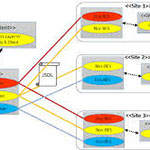 Campus Compute Cooperative (CCC): High-risk, novel, distributed computing exemplar project to demonstrate and investigate new ways of federating campus computing capabilities.
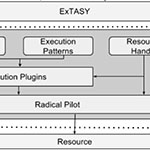 Extensible Tools for Advanced Sampling and analYsis (ExTASY): Executing iterative, coupled molecular simulation and analysis kernels on high performance computing systems.
 Fast fingerprinting & detection of materials using hand-held devices and high performance computing: Providing an application for cutting-edge material analysis which uses machine learning algorithms and high performance computing to process data gathered from hand-held infrared sensors.
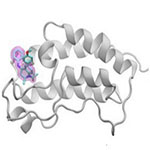 High-Throughput Binding Affinity Calculations (HTBAC): Enabling rapid, accurate, scalable and reliable free energy-based binding affinity calculations.
 Imagery Cyberinfrastructure and Extensible Building-Blocks to Enhance Research in the Geosciences (ICEBERG): Coupling open-source image analysis tools with the use of high performance and distributed computing (HPDC) for imagery-enabled geoscience research.
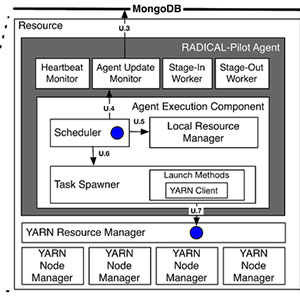 MIddleware for Data-Intensive Analytics and Science (MIDAS): Supporting new programming and execution models for data-intensive analysis in a wide range of science and engineering applications.
 Molecular Sciences Sustainable Software Institute (MolSSI): Enabling science, education, and cooperation to serve the worldwide community of computational molecular scientists.
 Polar Computing Research Coordination Network: Analyzing opportunities and barriers in the uptake of High-Performance and Distributed Computing methods and cyberinfrastructures for Polar Science.
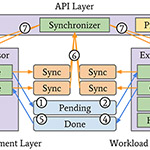 The Power of Many - Ensemble Toolkit for Earth Sciences: Enabling ensemble programming for simulating and analyzing climatic models and seismic wave data.
 RADICAL Cybertools (RCT) - Scalable, Interoperable and Sustainable Tools for Science: Scalable, Interoperable and Sustainable Tools for Science: Supporting scalable, interoperable and sustainable science on a range of high-performance and distributed computing infrastructures.
 Scalable Adaptive Large Ensembles of Molecular Simulations (SCALE-MS): Supporting algorithms that use large collections of molecular simulations to simulate the long timescales needed for scientific and industrial discovery.
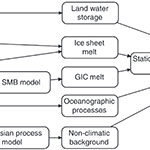 Sea-Level Rise - Intergovernmental Panel on Climate Change (IPCC): Developing a framework to explore scientific hypotheses pertaining to future sea-level change while reducing the amount of time and effort needed from the scientists and the amount of required computing resources.
Smart Decision Making using Data and Advanced Modeling Approaches: Enabling rapid, accurate, scalable and reliable free energy-based binding affinity calculations.
Sea-Level Rise - Intergovernmental Panel on Climate Change (IPCC): Developing a framework to explore scientific hypotheses pertaining to future sea-level change while reducing the amount of time and effort needed from the scientists and the amount of required computing resources.
Smart Decision Making using Data and Advanced Modeling Approaches: Enabling rapid, accurate, scalable and reliable free energy-based binding affinity calculations.
Past
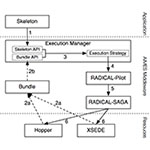 Abstractions and Integrated Middleware for Extreme-Scale Science (AIMES): Enabling extreme-scale distributed computing via dynamic federation of heterogeneous computing infrastructures.
 Cybermanufacturing: Advanced Modeling and Information Management in Pharmaceutical Manufacturing: Provide an cutting-edge material analysis application which uses machine learning (ML) algorithms leveraging HPC to process data gathered from handheld infrared sensors